



The Attention Economy Profits From Your Curiosity
How the Most Powerful Businesses in History Were Built on a Feeling You Were Born With
You did not choose to be curious.
Curiosity is not a preference, a personality trait, or a decision you made somewhere along the way. It is a biological inheritance — one of the oldest and most fundamental drives in the human nervous system. Long before language, long before civilisation, long before anything that resembles modern life, curiosity was already doing its work. Pushing early humans to investigate the unfamiliar. To approach the unknown rather than retreat from it. To ask, in whatever pre-verbal form the question took: what is that?
It is, without exaggeration, one of the primary reasons your species survived.
And it is now the primary raw material of a trillion-dollar industry.
This essay is about how that happened. How a drive that evolved to keep you alive became the mechanism through which your attention is harvested, packaged, and sold. How the platforms that now govern most of modern life — the feeds, the algorithms, the infinite scroll — were not designed to inform you, entertain you, or improve your life. They were designed to exploit something ancient and automatic inside you, so reliably and at such scale that it has become one of the most profitable business models ever constructed.
And why understanding this, precisely and without illusion, is the first step toward doing something about it.
The Neuroscience of Curiosity — Why You Cannot Ignore a Gap
Before examining how curiosity is exploited, it is worth understanding what it actually is — because the popular version of the concept undersells how deep it runs.
Curiosity is not simply an interest in new things. At the neurological level, curiosity activates the same dopaminergic pathways as hunger, thirst, and sexual desire. It is a genuine drive state — a condition of incompleteness that the brain registers as discomfort and seeks to resolve. When you encounter a gap between what you know and what you want to know, your brain does not neutrally register the gap. It experiences it as a kind of mild suffering, and it motivates behaviour aimed at closing it.
This is why you finish sentences that trail off. Why you need to know how a film ends even when it is bad. Why a notification on your phone — which might be nothing, might be anything — is almost impossible to ignore. The notification does not promise something good. It promises resolution. It promises the closure of a gap. And that promise is neurologically irresistible.
The psychologist George Loewenstein formalised this in 1994 with what he called the information-gap theory of curiosity. The theory is elegantly simple: curiosity arises when attention becomes focused on a gap in knowledge. The larger the gap feels, the stronger the curiosity. The more uncertain the resolution, the more powerful the pull.
This was an academic insight in 1994. By 2010 it was a product specification.
The Moment It Became a Business Model
The attention economy did not begin with social media. It began, in its modern form, with television — specifically with the discovery that advertising revenue could fund content production if the content was compelling enough to keep audiences watching.
The insight was simple: if you could reliably capture human attention, you could sell that attention to companies who wanted to place their products in front of it. Attention became currency. The programming was never really the product. The audience was.
But television had limits. You could only broadcast to people who were in front of a set. You could only run a fixed number of hours. The attention you could capture was constrained by time, geography, and the passive nature of the medium.
The internet removed all three constraints simultaneously.
Suddenly attention could be captured anywhere, at any time, for an unlimited duration. The audience did not just receive content — they generated it, shared it, commented on it, reacted to it. Every action produced data. Every data point improved the model. Every improvement in the model increased the accuracy with which the next piece of content could be targeted.
And the content that performed best — the content that reliably captured attention and held it — was not the most accurate, or the most useful, or the most true. It was the content that most effectively exploited the information gap. The content that made you feel like you were missing something. That made the gap between what you knew and what you might know feel unbearable.
The headline that trails off. The story that refuses to resolve cleanly. The claim that contradicts what you thought you knew. The statistic that seems impossible. The name you have never heard of suddenly appearing everywhere.
All of it engineered, consciously or through algorithmic optimisation, to produce the specific neurological state that George Loewenstein described thirty years ago in an academic paper that nobody outside psychology read.
The Three Mechanisms
The attention economy does not operate through a single mechanism. It operates through at least three, working simultaneously, each reinforcing the others.
The first is the information gap. As described above — the engineered feeling that you are missing something important, that resolution is one click away, that the gap between what you know and what you need to know is both significant and closable. Every headline is a tiny act of violence against your sense of completeness. Every thumbnail promises a resolution that the content frequently fails to deliver.
The second is social proof. Humans are intensely social animals. We evolved in small groups where knowing what other members of the group were paying attention to was critical survival information. If everyone in the tribe was looking in the same direction, there was probably a reason. That attentional alignment mechanism is ancient, automatic, and essentially impossible to override by will alone.
Trending lists, view counts, share numbers, likes, follower counts — all of these are social proof signals. They say, in effect: other people are paying attention to this. And your nervous system, reading that signal through the same ancient filter it uses for everything, interprets it as: this matters. Not because it necessarily does. But because other people are looking at it.
This is why a story about a person nobody has ever heard of can capture the attention of millions overnight. It is not the story that matters. It is the signal that millions of other people are paying attention to it. That signal is more compelling than the story itself.
The third is variable reward. This is the most insidious mechanism, and the one most directly responsible for compulsive platform use. Variable reward — the unpredictable, intermittent delivery of something stimulating — is the most powerful conditioning mechanism in behavioural psychology. It is the same mechanism that makes slot machines more addictive than games with predictable payouts. The uncertainty is not a bug. The uncertainty is the feature.
When you scroll a feed, you do not know what the next post will be. It might be boring. It might be fascinating. It might be funny, or outrageous, or touching, or infuriating. The unpredictability of that sequence is precisely what makes it impossible to stop voluntarily. Your brain is not looking for the next interesting post. Your brain is running a reward-seeking loop that can only be interrupted by external force, because there is no natural stopping point built into the experience.
This was not an accident. The infinite scroll — the design pattern in which content loads continuously with no page breaks — was invented specifically to remove the natural pause that would allow a person to make a conscious decision about whether to continue. The inventor of infinite scroll has publicly expressed regret about it.
What Your Curiosity Is Actually Worth
In 2023, Meta — the parent company of Facebook and Instagram — generated approximately $117 billion in revenue. Google's parent company Alphabet generated approximately $307 billion. TikTok's owner ByteDance is estimated to have generated over $80 billion.
None of these companies sell products in the traditional sense. They do not manufacture anything. They do not extract natural resources. They do not provide a service you pay for directly.
What they sell is your attention. Specifically, they sell the attention of people whose curiosity has been successfully activated and whose behaviour has been shaped by the three mechanisms described above.
Every time you click on a headline because the information gap was unbearable. Every time you opened an app because you needed to know what you were missing. Every time you kept scrolling because the next post might be the interesting one — that behaviour was the product being sold. The advertiser paid for access to your activated, engaged, curiosity-driven attention. The platform delivered it reliably at scale.
Your curiosity, which evolved over hundreds of thousands of years to help you understand the world, is now the primary raw material of some of the largest and most profitable businesses in human history.
This is not a conspiracy theory. It is not a metaphor. It is a straightforward description of the business model, as stated in the public filings, investor presentations, and product documentation of the companies in question.
How the Attention Economy Substitutes for Real Curiosity
What makes this arrangement particularly damaging is not simply the time it consumes — though it consumes extraordinary quantities of time. The deeper problem is what it substitutes for.
Curiosity is finite within any given period of time. The neurological drive state has limits. When your curiosity is repeatedly activated and partially satisfied by platform content — the endless cycle of information gaps opened and imperfectly closed, questions raised and never quite answered — you arrive at the end of a scroll session in a particular state. You feel like you have been intellectually active. You feel vaguely informed. You feel like something happened.
But very little has actually changed. No new capability has been built. No genuine understanding has been deepened. No problem has been solved. The curiosity that drove the session was never satisfied — it was agitated, briefly stimulated, and then redirected to the next agitation.
Meanwhile, the genuinely curiosity-worthy questions sit untouched. The book you intended to read. The skill you told yourself you would develop. The idea you wanted to think through properly. These things require the same neurological resource — sustained, directed curiosity — that was just spent on a feed that returned almost nothing of value.
This is the substitution problem. Not that the platforms are interesting when they should be boring. But that they are just interesting enough to consume the resource that would otherwise go toward something that would genuinely change your life.
A chocolate bar is not a meal. But if you eat the chocolate bar at the moment you are hungry, you arrive at dinner no longer hungry enough to eat what would actually nourish you. The damage is not in the chocolate bar. It is in what the chocolate bar prevented.
The Honesty the Industry Rarely Offers
There is a conversation that does not happen often enough, because it is uncomfortable for almost everyone involved.
The platforms that operate the attention economy are not neutral utilities. They are not, in any meaningful sense, serving your interests. They are businesses optimised for a single metric — engagement — and engagement is not the same as value, truth, utility, or wellbeing. Engagement is simply the measurement of how successfully your attention was captured and held.
Content that makes you angry is highly engaging. Content that confirms your existing fears is highly engaging. Content that presents unresolved uncertainty is highly engaging. None of these categories are reliably correlated with content that improves your understanding of the world, helps you make better decisions, or contributes to your long-term flourishing.
The people who design these systems are not malicious. Many of them genuinely believe they are connecting the world, democratising information, giving voice to the voiceless. These things are also true. The attention economy has produced genuine goods alongside its genuine harms.
But the structural incentive of the business model points in one direction: toward whatever maximises the time you spend on the platform, regardless of whether that time is good for you.
Knowing this is not enough to change your behaviour — the mechanisms are too deep and too well-designed for awareness alone to override them. But it is a necessary prerequisite for the kind of deliberate, structural response that actually works.
How to Reclaim Your Attention From the Attention Economy
The instinctive response to understanding the attention economy is a kind of moral panic — a desire to delete everything, go off-grid, declare the whole thing corrupt and walk away.
This is not realistic for most people and it is probably not necessary.
The more useful response is to treat your attention the way a serious investor treats capital. Not with panic or denial, but with deliberate allocation. The question is not whether to engage with platforms — for most people in most contexts, some level of engagement is both inevitable and appropriate. The question is whether the engagement is chosen or automatic. Whether it serves your purposes or theirs.
A few structural principles that work not because they are clever but because they address the mechanisms directly:
Separate consumption from creation. The platforms are designed for consumption. If you are using them to create — to publish, to connect, to build an audience — you are using them against their default grain, and that is worth doing. Passive consumption and active creation are not equivalent uses of the same tool. One extracts value from your attention. The other potentially generates it.
Satisfy curiosity with depth, not breadth. When a question genuinely interests you, go deep on it rather than wide. Read the book rather than the article. Read the article rather than the thread. Read the thread rather than the headline. Each step deeper returns more genuine resolution to the curiosity that drove the question. The platforms are engineered to keep you wide — jumping from stimulus to stimulus without ever going deep enough to actually satisfy the drive.
Design your information environment rather than inheriting it. Most people's information environment is whatever the algorithm decides to surface. The alternative — actively curating what you read, from which sources, in what sequence — requires more effort but returns dramatically more value per unit of attention spent. The distinction is between an information diet and an information binge.
Use the same curiosity that's being exploited, but aim it deliberately. Curiosity is not the problem. Undirected curiosity is the problem. The same drive that makes you click on a trending headline can be aimed at a chapter of a book, a difficult concept, a skill you are developing. The neurological mechanism is identical. What differs is the object it's pointed at and who decided what that object would be.
A Final Thought
Curiosity is not a weakness to be defended against. It is one of the finest things about being human. It built civilisation. It is the engine of every scientific discovery, every work of art, every philosophy worth reading, every business worth building.
The tragedy of the attention economy is not that curiosity exists. It is that one of humanity's greatest cognitive gifts has been identified, mapped, and systematically exploited for profit at a scale that would have been unimaginable a generation ago.
The companies that built this system did not create your curiosity. They found it. They studied it. They built billion-dollar infrastructure around its specific neurological contours. And they did it so well that most people engaging with their platforms every day have no clear sense of what is happening or what it is costing them.
Understanding this does not make you immune. It makes you honest.
And honesty — about where your attention actually goes, what it is actually worth, and who is currently profiting from it — is the beginning of getting it back.
Attention is currency.
The question is not whether you are spending it.
The question is whether you know who you are spending it with.
Explore more:
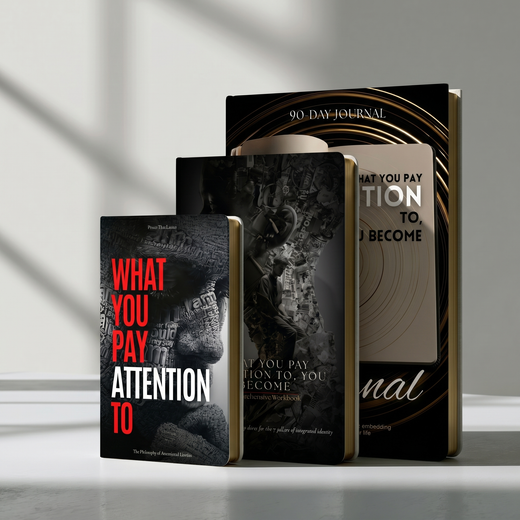
Attention Is Currency — Book 1 of the Focus Series.
The Focus Reset System — a structured framework for reclaiming your attention.
Essays — long-form thinking on attention, identity, and the modern mind.