
The Collage Self: What Happens to Identity When Everything We Consume Becomes Us
The Collage Self: What Happens to Identity When Everything We Consume Becomes Us
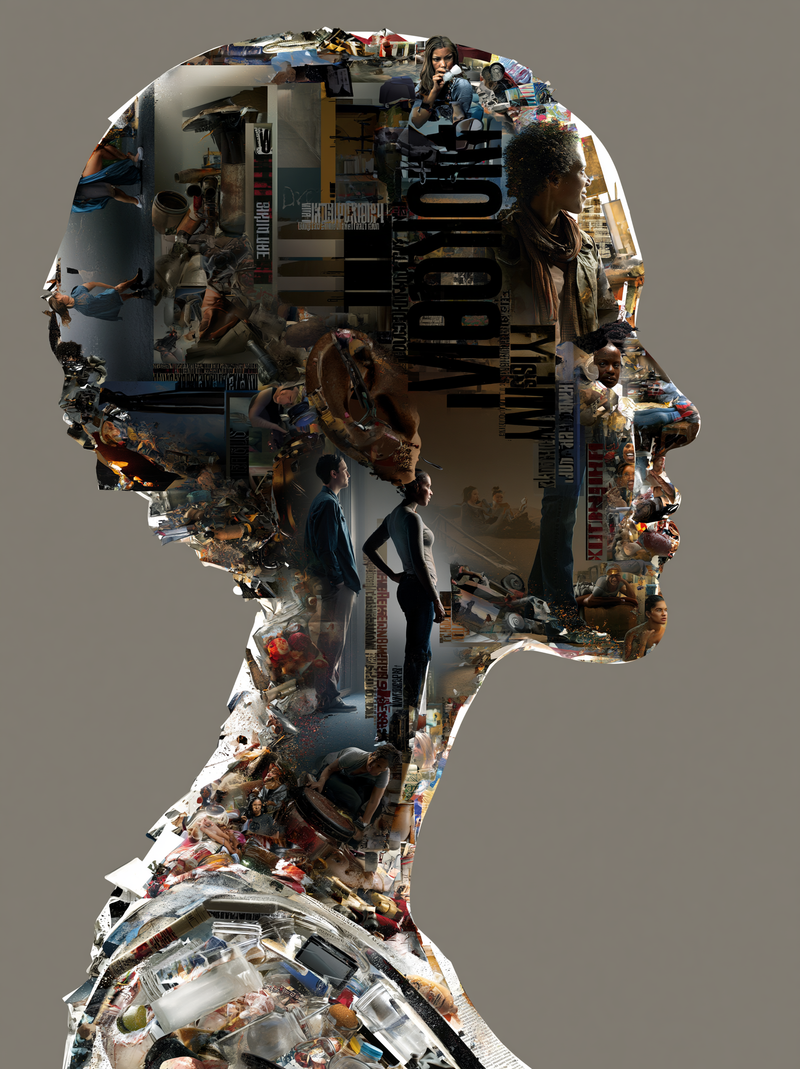
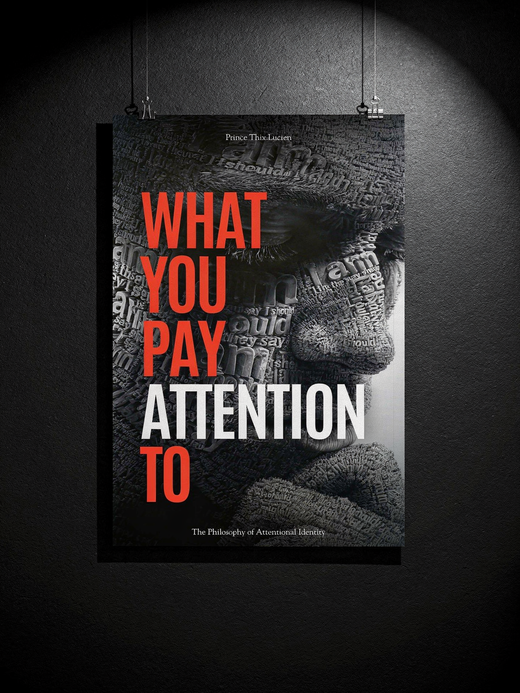
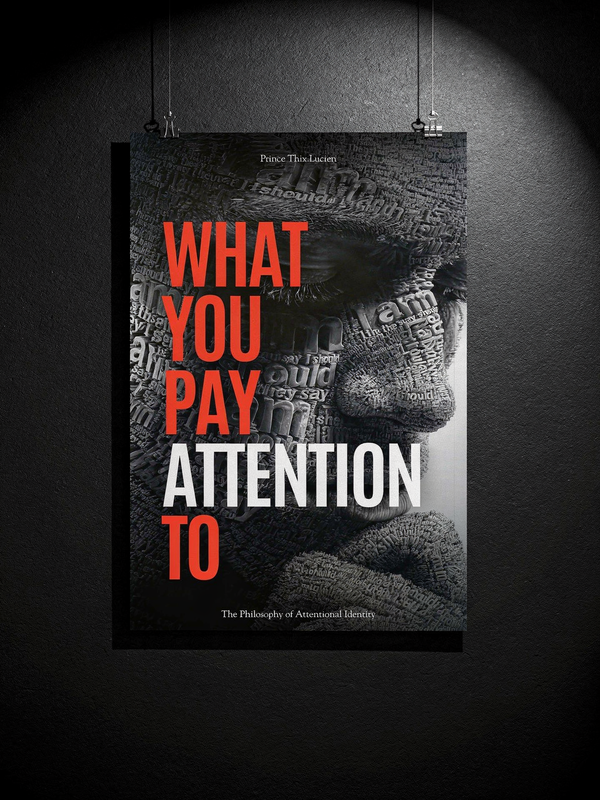
There is an image worth sitting with before we begin. A head, shown in profile, rendered not in skin and thought but in a dense collage of other people's material — strangers mid-gesture, product shots, torn headlines, fragments of rooms that belong to no one in particular. Nothing inside the silhouette was made by the person it depicts. The shape is human. The contents are borrowed.
It is an uncomfortable image to look at for long, because it does not feel like exaggeration. It feels like description.
The Mind as Archive, Not Author
We tend to imagine the self as something authored — a set of convictions, tastes, and positions we arrived at through experience and reflection. But look honestly at where most of what fills a modern mind actually comes from, and the picture changes. A headline glimpsed before coffee. A stranger's opinion, delivered with more confidence than evidence. An advertisement disguised as a lifestyle. A short video, then another, then forty more, none chosen so much as arrived at.
None of this is inherently sinister. Humans have always been shaped by what surrounds them — myth, gossip, scripture, newspapers, television. What has changed is volume, velocity, and design. The average mind today receives more discrete pieces of information before breakfast than a person a century ago might have received in a week. And almost none of it was requested with any real deliberation. It simply entered, the way weather enters a house through an open window.
The result is a kind of interior archive that grows without an archivist. Fragments accumulate. Few are ever reviewed, catalogued, or discarded. The self becomes less like a considered composition and more like the collage in the image — dense, layered, and largely accidental.
Attention as the Site of Construction
Attentra's founding claim — that attention is currency — is not a metaphor about productivity. It is a claim about identity. Whatever receives sustained attention does not stay outside a person. It gets built in. This is not a philosophical abstraction; it is closer to a description of how memory, belief, and self-concept actually form. Repetition of exposure shapes what feels normal, desirable, true, and urgent, regardless of whether it was ever consciously endorsed.
This is precisely why the architecture surrounding modern attention was not designed by accident. Feeds, notifications, autoplay, infinite scroll — these are not neutral delivery mechanisms for information a person has already decided to seek. They are structures optimized to capture attention regardless of its correspondence to that person's actual values, and to hold it for as long as possible once captured. The economic incentive of most digital platforms is not to inform a mind. It is to occupy one.
Understood this way, the collage-head is not a metaphor for excess. It is closer to a diagram. Every fragment inside that silhouette got there because something — an algorithm, an advertiser, a stranger's engagement bait — successfully claimed a slice of attention that the person never consciously allocated. Multiply that by years, and the resulting interior looks exactly like the image: crowded, fragmented, largely composed of material with no relationship to the life it now occupies.
The Myth of the Neutral Feed
There is a common defense against this observation, which is that consumption is passive and therefore harmless — that scrolling, browsing, half-watching is simply filling time, not building anything. This defense does not survive scrutiny.
Nothing that repeatedly occupies attention is neutral. What a person watches, reads, and absorbs on a loop becomes the material from which comparisons are made, standards are set, and identities are quietly assembled. A person who spends years absorbing curated images of other people's lives will, whether they intend to or not, begin measuring their own life against a standard they never chose and could not have chosen, because it was never presented as a choice. It was presented as ambient noise.
This is the deeper cost of the "neutral feed" — not that it wastes time, but that it builds, silently and without consent, an internal architecture that competes with whatever the person might otherwise have constructed on purpose. Two structures cannot occupy the same interior space indefinitely. One will dominate. Left unattended, it is rarely the one the person would have chosen deliberately.
Noise as a Structural Condition, Not a Personal Failing
One of the most quietly damaging ideas in contemporary self-help culture is that distraction, burnout, and fragmented focus are primarily failures of individual discipline — that a person who cannot concentrate simply needs more willpower, a better morning routine, a stricter schedule. This framing is not just unkind. It is inaccurate.
The scattered, overloaded mind depicted in the collage image is not evidence of personal weakness. It is the expected output of an environment engineered, at enormous financial cost, to produce exactly that outcome. Blaming an individual for the effects of a system built by some of the most resourced companies in human history — companies employing behavioral scientists specifically to make disengagement difficult — is a category error. It is like blaming a person for gaining weight in an environment deliberately engineered, at every turn, to make overeating the path of least resistance.
This distinction matters because it changes the nature of the response required. If fragmentation were purely a personal failing, the answer would be more self-criticism. But if it is structural — if it is the predictable result of an attention economy operating exactly as designed — then the answer is not shame. It is architecture. The person needs a different structure to inhabit, not a harsher inner voice.
The Cost of an Unedited Self
What actually happens to a person who accumulates identity this way, passively, over years, without editing?
The most immediate cost is coherence. A self built from thousands of unrelated fragments struggles to sustain long projects, because long projects require a stable center capable of returning to the same intention across weeks or months, and a fragmented interior offers no such stability — only the next input, and the one after that. This is one of the less-discussed mechanisms behind modern burnout: not simply overwork, but the exhaustion of maintaining a self with no fixed architecture, constantly reassembled by whatever entered most recently and most forcefully.
The second cost is conviction. A mind saturated with other people's opinions, delivered at high volume and with artificial confidence, finds it increasingly difficult to locate its own position on anything. Not because the person lacks intelligence, but because the internal space where a considered position would normally form is already occupied — by noise that arrived faster and louder than reflection ever could.
The third cost is the hardest to name, and perhaps the most important: a quiet, persistent sense of unfamiliarity with one's own life. The feeling of having consumed enormously and produced almost nothing. Of recognizing, on some level, that a great deal of interior space is occupied by material that was never chosen — that the self, examined closely, looks uncomfortably like that collage: dense, human-shaped, and composed almost entirely of other people's lives.
Composition, Not Consumption
The response to this condition is not abstinence. A completely closed mind is not the goal, and it is not achievable in a connected world, nor would it be desirable if it were. The alternative to indiscriminate consumption is not withdrawal. It is composition.
Composition means treating what enters the mind the way a serious editor treats a manuscript — not everything that arrives deserves to stay, and the discipline of a considered life is largely the discipline of selection. This is a fundamentally different posture than "digital minimalism" understood as mere reduction. It is not about consuming less in some abstract, quantified sense. It is about consuming on purpose — choosing what earns a place in the interior architecture, and treating attention as something too valuable to spend by default.
This is also where structure becomes indispensable, because intention alone rarely survives contact with an environment engineered to override it. A person who simply resolves to "be more mindful" about their attention is, in most cases, quietly outmatched by systems built by teams of specialists whose entire function is to defeat exactly that resolve. What holds against that kind of engineered pressure is not willpower in the moment. It is structure decided in advance — fixed points, repeatable practices, and frameworks that do the deciding before the moment of temptation ever arrives. This is the entire logic behind treating focus, identity, and calm not as moods to be summoned, but as systems to be built and maintained.
Reclaiming the Center
There is a version of the collage image that is not tragic. Imagine the same silhouette, still dense, still layered — but composed deliberately. Every fragment chosen. Nothing accidental. A self still built from many inputs, because no self exists in isolation, but assembled the way a curator assembles an exhibition rather than the way a browser tab accumulates history.
This is not a call to austerity. It is a call to authorship. The difference between the two versions of that same silhouette is not the amount of material inside it. It is whether a deliberate mind selected what belongs there.
Reclaiming that authorship starts small: a single hour genuinely protected from ambient noise. A single feed unfollowed not out of anger but out of clear-eyed audit. A single structured practice — a journal, a reset framework, a defined block of undistracted work — repeated until it becomes the default rather than the exception. None of these acts are dramatic. Their power is cumulative, the same way the noise they counteract accumulated: fragment by fragment, day by day, until the interior architecture shifts from something that happened to a person into something a person actually built.
Conclusion
The collage-head is not a warning about the future. It is closer to a mirror held up to the present — an accurate rendering of what an unedited, unstructured, endlessly receptive mind gradually becomes. The image is unsettling not because it is exaggerated, but because it is not.
The corrective is not to consume nothing. It is to consume like someone who understands that attention is the raw material of identity, and to build — deliberately, structurally, one protected hour at a time — a self that was actually composed, rather than merely accumulated.
If any part of this essay described something familiar — the sense of a mind crowded with material you never chose — Attentra's Systems collection was built for exactly this problem: structured tools for auditing what has been let in, and rebuilding a center on purpose.
FAQ
Is constant information consumption actually harmful, or is this just alarmism? The concern is not information itself but the absence of selection. Unedited, high-volume consumption without deliberate filtering has been linked in cognitive and psychological research to reduced sustained attention and increased subjective overwhelm — the issue is structural exposure, not any single piece of content.
Is this the same thing as "digital minimalism"? Related but distinct. Minimalism as commonly discussed focuses on reducing volume. Composition, as described here, focuses on deliberate selection — the goal is not less input by default, but chosen input by design.
Why frame this as identity rather than productivity? Because the deeper cost of unfiltered attention is not lost hours — it is a self quietly assembled from material that was never consciously chosen. Productivity frameworks address output; this essay addresses the underlying architecture of the self producing it.
Where should someone start if this feels overwhelming? With a single audit, not a full overhaul: identify one recurring input (a feed, an app, a habit) that occupies significant attention without deliberate choice, and remove or replace it with one structured practice repeated consistently.

What Are Journals & Workbooks?
A short guide to the difference between the two — and why writing is what turns insight into something you actually do.